
Money laundering and terrorism financing are among the most serious threats facing the global financial system today. These crimes allow illegal money to enter legitimate channels, fund violent activities, and weaken economic stability across countries.
When financial systems are misused, the impact goes far beyond banks. It affects governance, public safety, and overall social well-being. Banks sit at the center of this risk.
Even a single overlooked red flag in a transaction among the large volumes of transactions processed every day can lead to severe financial losses, regulatory penalties, and reputational damage. This is why AML and CFT training for bank officials is not just a regulatory requirement, but a critical line of defense.
In this blog, we will look into the key benefits of AML and CFT training for bank officials and financial institutions
AML/CFT training is a structured program that educates bank staff on the legal, procedural, and operational aspects of preventing money laundering and terrorism financing. The goal is to create a workforce that can proactively prevent the bank from being exploited by financial criminals.
With AML/CFT training, trainees get to understand the following topics:
Understand money laundering, terrorism financing, and proliferation financing methods
AML/CFT Related International Bodies
Regulatory Bodies and Prevailing Laws and Regulations in Nepal
ML/TF Supervision and Supervisory Guidelines
Reporting Mechanisms
National Initiatives, regulations, and supervisory guidelines on AML/CFT
Mutual Evaluations and Assessment of AML/CFT Effectiveness
All bank officials involved in customer interaction, transactions, and financial operations should receive AML/CFT training. This includes:
Front-line staff handling accounts, deposits, and payments
Employees in KYC and onboarding roles
Risk management and compliance teams
Contractual staff handling financial operations
Senior management and AML Compliance Officers
Now, let’s look into the advantages it brings to the bank officials.
We have covered five advantages of AML/CFT training.
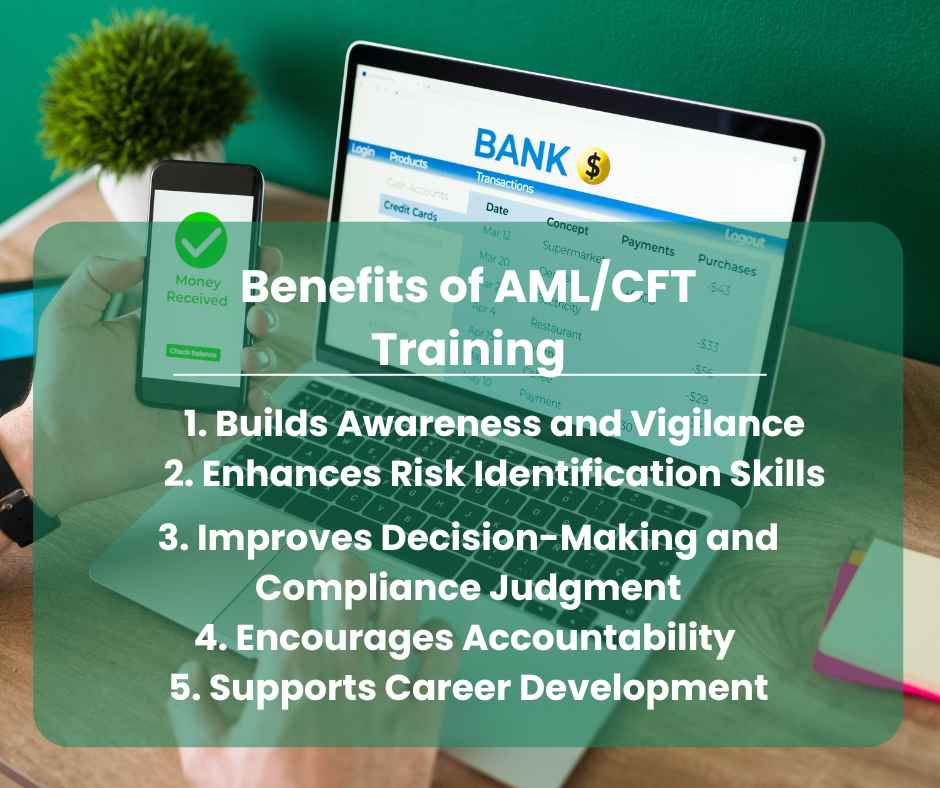
First and foremost, AML/CFT training educates the bank officials about the schemes of money laundering and how terrorism financing operates. With this training, officials learn to recognize patterns in structuring deposits to layer funds across multiple accounts, which is often unnoticed.
This level of awareness ensures that officials are vigilant so that they can spot unusual transactions or behavior that may indicate financial crime.
Bank officials handle thousands of transactions every day. When they are familiar with the concept of AML/CFT, they can double-check transactions and identify any unusual or suspicious transaction patterns.
Further, they can look out for any discrepancies in customer information while also being able to recognize high-risk clients and jurisdictions. By developing these skills, officials act as the first line of defense against financial crime.
After being aware and alert, it is equally essential to make the right decision to prevent terrorism and money laundering-related activities. AML/CFT training enables officials to deal with the situation logically. They can take the right action regarding:
When to escalate concerns to compliance officers
How to document suspicious transactions accurately
How to make decisions that comply with both local and international regulations
Their right action at the right time reduces errors and ensures that decisions align with regulatory expectations.
AML/CFT training can make the sense of responsibility in bank officials stronger. During the training, past activities related to money laundering and funding terrorism help officials map out the serious consequences.
These consequences are not only harmful for the bank, but also for the national financial system, along with possible human and physical resources destruction.
The accountability instilled by this training ensures that employees do not overlook potential risks and contributes to a strong culture of compliance and integrity.
In terms of spotting and preventing any destruction activites, AML/CFT training is the best. But it also helps in uplifting the career since this knowledge is a critical skill for banking professionals.
In fact, officials trained in AML/CFT are better equipped for promotions, risk management roles, and compliance responsibilities.
This training not only improves individual expertise but also strengthens internal leadership pipelines for compliance and risk management.
Banks can also enjoy benefits such as:
Strengthened regulatory compliance, which reduces the risk of fines, penalties, or legal action.
Protection of the bank's reputation in the market and credibility with customers,
Reduction of financial crime risk and maintaining operational stability.
Long-term risk management and sustainability support.
AML/CFT training works best when delivered using multiple approaches:
Instructor-led classroom training, which includes practical scenarios and real-life cases
Workshops and discussions where group exercises for problem-solving can be conducted
Case studies that include analysis of real money laundering and terrorism financing examples
Refresher courses, which are all about regular updates for ongoing awareness
Online courses via LMS that offer flexible learning with modules and assessments
ARKBO technology is devoted to improving corporate training and learning. In fact, ARKBO LMS is the most loved training platform by banks in Nepal. In addition to our corporate mental health course and business etiquette course, we also provide an AML/CFT course for the banking officials of Nepal. This course includes:
AML/CFT Legal and Regulatory Framework in Nepal
Customer Due Diligence (KYC, CDD, EDD)
Suspicious Transaction Monitoring and Reporting
Risk Management and Compliance Responsibilities
With ARKBO’s AML/CFT course, bank officials gain the confidence and knowledge to act as a strong line of defense against financial crime.
And this course is created by Kathmandu FinteK, which is a firm driving digital innovation in finance through collaboration and expertise in Nepal.
In today’s age, AML/CFT training for bank officials is essential. It empowers employees to detect and prevent financial crimes, strengthens compliance culture, and protects the bank’s reputation.
By investing in AML/CFT training, banks can reduce financial and regulatory risks, ensure operational integrity, and prepare their workforce for evolving challenges in the financial industry.
ARKBO has introduced its own AML/CFT training for the banks. It is easy, accessible, and covers the fundamentals necessary for bank officials.
To know more about the course or to proceed with your purchase, you can contact us.