
Elections are the foundation of any democratic system, as they bring renewal, new leadership possibilities, and policy shifts.
However, the period around an election often comes with economic uncertainty, slower market momentum, and cautious financial decision-making. Businesses may experience slower payments, longer sales cycles, and tighter cash flow management.
Nepal, which recently suffered the tragic loss of more than 70 people during the Gen Z movement, is now set to elect a new government. On Falgun 21, the nationwide election will be held.
Although an election is a form of people’s win, it mayn’t be a good time for GDP growth. Rather, Nepal’s GDP is expected to decline in fiscal year 2026/27 due to political transition and instability. This slowdown can directly affect business revenue, hiring plans, expansion strategies, and overall operational stability.
During this transition period, companies must shift their mindset. Instead of reacting emotionally, organizations should focus on strengthening internal efficiency by reducing operational costs.
But how can that be done? This guide will help you understand practical solutions.
Let us begin by understanding the impact political uncertainty can have on your business.
The Economic Impact of Political Uncertainty in Nepal
Political uncertainty affects businesses both directly and indirectly.
In Nepal, the private sector contributes 81.5 percent of GDP and more than 85 percent of total employment. When business confidence declines, the impact spreads across industries, including retail, hospitality, finance, education, and technology.
Election-related activities such as campaign logistics, advertising, transportation, and hospitality services may create short-term economic activity. However, this does not necessarily strengthen long-term productivity or structural growth.
Frequent leadership changes and policy adjustments make long-term planning difficult. As a result, many business owners delay expansion, investment, and hiring decisions until policy direction becomes clearer. In such an environment, operational efficiency becomes a key competitive advantage.
As economic growth slows, several operational pressures begin to surface:
Cash conversion cycles become longer
Customer approvals take more time
Administrative expenses increase
Manual processes create bottlenecks
Budget reviews become stricter
Hidden inefficiencies that were previously considered manageable become more visible. Manual data entry, paper-based approvals, fragmented communication tools, and outdated infrastructure begin to drain productivity.
At this stage, reducing operational costs is necessary. However, the problem arises when businesses implement aggressive cost-cutting without a clear strategy.
This can damage long-term capability. Reducing workforce, delaying innovation, or pausing essential improvements may weaken competitive positioning.
The smarter approach is cost optimization. Cost optimization focuses on achieving higher output with lower waste. It emphasizes automation, digital systems, process improvement, and transparency.
There is a common misconception that reducing operational costs limits organizational growth. This is not true. In reality, strategic cost optimization strengthens an organization.
Effective cost control involves:
Eliminating wasteful processes
Automating repetitive tasks
Improving visibility and transparency
Strengthening digital infrastructure
Enhancing productivity
Organizations that improve efficiency during slow cycles create a competitive advantage. When economic stability returns, these companies operate with leaner structures, faster processes, and stronger systems.
Now, let's focus on the practical strategies Nepali companies can implement to reduce operational costs during the election period.
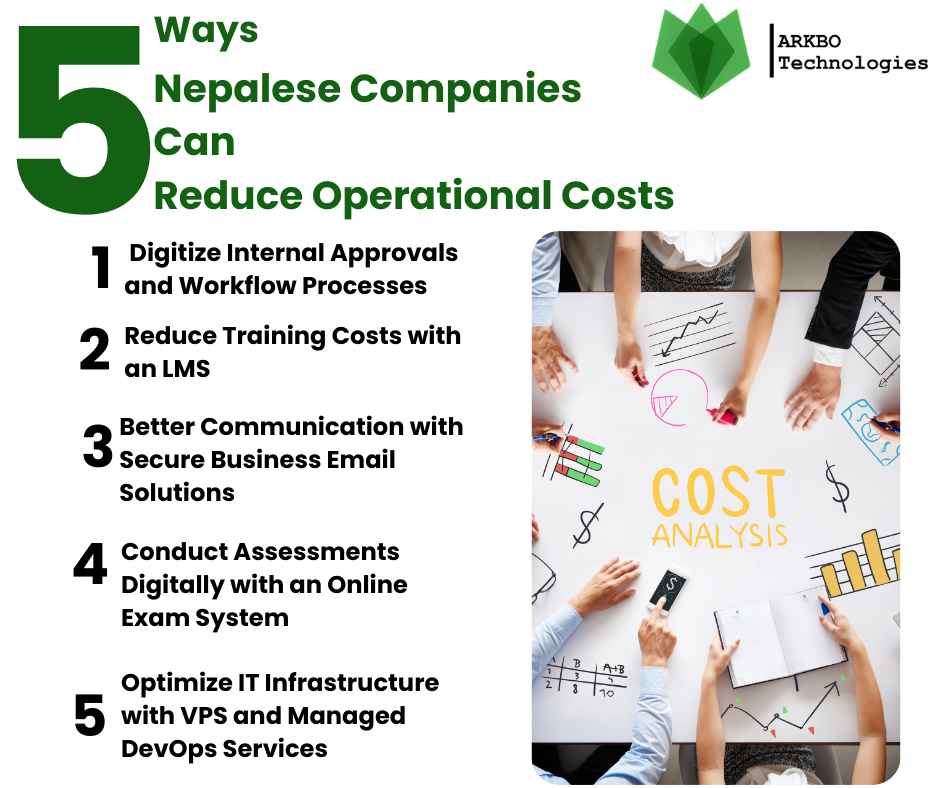
Many organizations in Nepal still rely on manual approval systems for leave requests, purchase orders, expense reimbursements, vendor approvals, and HR documentation.
Manual systems come with several hidden costs, including:
Lost or duplicated documents
Delayed approvals that slow projects
Excessive follow-ups and administrative workload
Lack of accountability and tracking
These inefficiencies consume valuable time and resources.
By implementing Office Automation and Workflow Systems, businesses can centralize administrative operations, automate approval routing, and track progress in real time.
With such systems in place, organizations benefit from:
Faster decision-making
Reduced paperwork
Clear audit trails
Lower administrative overhead
Improved transparency
Digital workflows transform routine tasks into structured processes. What once required multiple emails and physical signatures can now be completed within minutes. Over time, these efficiencies lead to significant cost savings.
Employee training remains essential, even during uncertain economic periods. However, traditional in-person training programs may not always be practical during such times. Pausing training can negatively affect employee competence, skills, and productivity.
To ensure learning continues without interruption, organizations can implement a Learning Management System. An LMS allows structured training to be delivered digitally.
With an LMS, companies can:
Onboard employees efficiently
Provide compliance and policy training
Offer skill development programs
Track participation and performance
Update content centrally
Employees gain flexibility to learn at their own pace. Meanwhile, management gains measurable insights into performance and training effectiveness.
Digital learning eliminates repetitive physical sessions. Training modules can be reused without increasing costs. For Nepalese organizations, adopting an LMS reduces recurring training expenses while strengthening workforce capability.
Email remains one of the most preferred communication channels in professional settings. However, communication infrastructure is often overlooked when evaluating operational efficiency.
Many companies still use free email platforms for official communication. While convenient, these tools may lack advanced security, centralized management, and professional branding.
Investing in secure business email solutions helps prevent data leakage, phishing attacks, and communication mismanagement.
A professional corporate email solution offers:
Domain-based corporate identity
Enhanced data protection
Centralized administrative control
Policy enforcement and compliance tracking
Improved team collaboration
Secure business emails strengthen brand credibility when interacting with clients, investors, and partners. During uncertain periods, trust and security become even more critical. Investing in secure communication tools enhances operational stability.
To ensure you hire the right talent and evaluate team expertise effectively, assessments are necessary. In Nepal, many evaluations are still conducted through traditional paper-based methods that require physical space, manual grading, and record keeping. These processes are time-consuming and resource-intensive.
An Online Exam and Assessment System provides a more efficient solution.
Such systems help organizations:
Evaluate employee knowledge efficiently
Run certification programs
Identify skill gaps
Align training with performance data
Store results digitally for analysis
Online assessment systems reduce repetitive retraining and enable data-driven HR decisions. By accurately measuring competency, companies can allocate training budgets more effectively and avoid unnecessary expenditure.
IT infrastructure represents a significant cost center for many businesses. Maintaining on-premises servers requires hardware investment, maintenance costs, backup systems, electricity consumption, and dedicated IT personnel.
During uncertain economic periods, cloud-based infrastructure becomes a practical solution. This allows companies to focus on strategic initiatives instead of infrastructure maintenance.
Shifting to Virtual Private Servers and managed DevOps services offers several advantages:
Predictable monthly costs
Reduced hardware dependency
Improved uptime and reliability
Scalable capacity based on actual usage
Enhanced data security
Optimizing IT infrastructure ensures long-term cost efficiency and operational stability.
How ARKBO Technologies Supports Nepalese Organizations?
During times of political and economic uncertainty, technology partners should function as strategic allies.
ARKBO Technologies, a leading provider of corporate software solutions in Nepal, delivers digital systems that directly reduce operational inefficiencies and improve productivity.
Our core solutions include:
Secure Business Email Solutions
Managed DevOps and Infrastructure Optimization
Each solution is designed with cost efficiency, scalability, and operational resilience in mind.
In addition, ARKBO offers ARKBO courses such as employee mental health training, compliance training, AML/CFT awareness, and business etiquette programs to support workforce development and work-life balance.
Final Thoughts
Election periods bring both excitement and uncertainty. When outcomes are positive, the country moves forward. When instability continues, the business sector feels the impact most strongly.
To stay prepared, operational improvements must be implemented during uncertain periods to create long-term value.
Companies should respond strategically rather than reactively. By focusing on digital transformation, automation, and process optimization, Nepalese businesses can reduce operational costs without sacrificing productivity or growth.
ARKBO can serve as your digital transformation partner and help your business thrive internally.
To see ARKBO solutions in action, you can book a demo of the products that best fit your organization’s needs.