
In today’s evolving workplace, leadership is no longer limited to managers or executives. Organizations increasingly rely on employees at every level to take initiative, collaborate effectively, and contribute to shared goals. Thus, employee leadership training becomes a vital component of modern workforce development.
As businesses face rapid change, competition, and growing complexity, developing leadership skills across the workforce is no longer optional; it’s essential. In this blog, we will look into the importance of employee leadership.
Employee leadership training is an important corporate training type that equips employees with the necessary skills to effectively guide, support, and manage their teams.
This kind of structured learning program is designed to develop skills as follows:
Communication skills, which include active listening, clear instruction, conflict resolution, and motivating teams.
Strategic thinking skills, which cover decision-making frameworks, planning, and understanding long-term impact.
Delegation, coaching, empowering team members, and driving change under management.
Ethical leadership covers integrity, accountability, and considering stakeholder impact.
Emotional Intelligence skills for developing empathy, self-regulation, and building trust.
Let’s look at the six major benefits of employee leadership training.
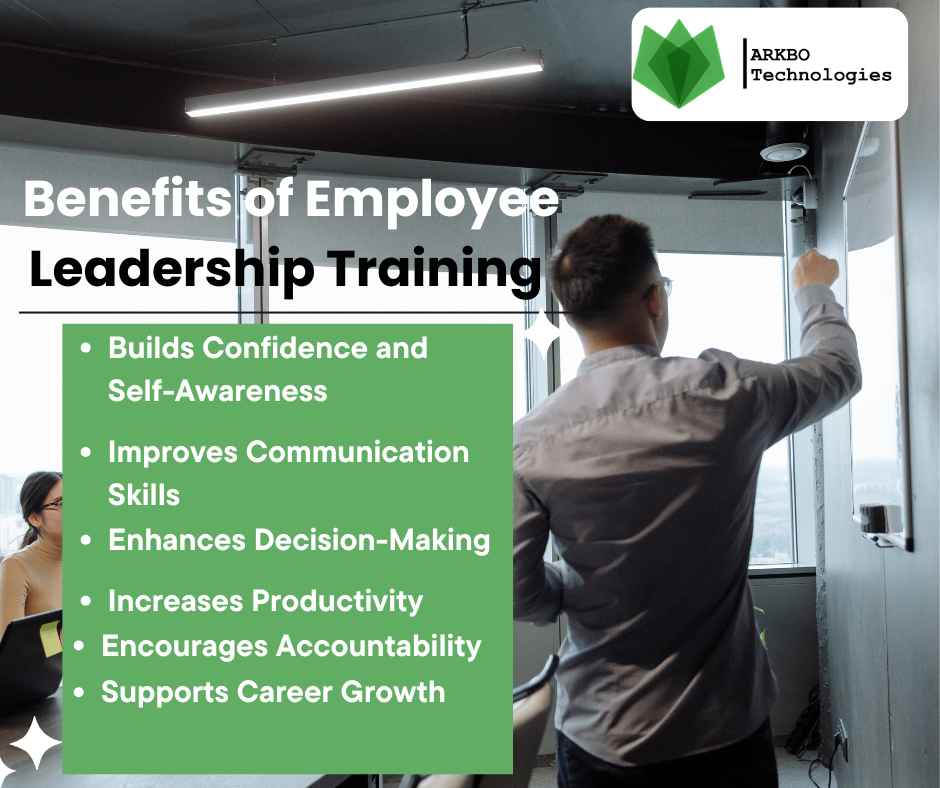
Self-awareness makes a significant impact on employee performance. It can make 32.3% of changes in productivity, turnover intentions, quality of work, and efficiency (ijecm). Thus, having self-awareness in employees is important. This self-awareness helps employees build confidence, encouraging them to speak up, take initiative, and handle challenges.
Employee leadership training helps employees clearly understand their own strengths, weaknesses, leadership styles, and behavior at work. With self-reflection, feedback, and guided learning, employees can be more aware of how their own actions can affect fellow employees.
According to SimonandSimon, 97% of employee believe that communication affects their task efficacy daily, and 70% of the workforce would be more productive with better communication processes.
With effective leadership training, employees can have better communication skills. Employees can learn how to express ideas clearly, listen actively, and provide constructive feedback. This reduces misunderstandings and improves collaboration across teams.
With leadership training, employees can have improved decision-making skills. Employees can learn to analyze the challenges, evaluate options, and choose solutions aligned with organizational goals. This leads to quicker decisions, fewer mistakes, and better outcomes aligned with organizational goals.
Leadership training enables employees to prioritize their tasks, manage their workloads, and delegate responsibilities effectively. By concentrating on the most significant tasks, they can save time on less critical activities and accomplish more efficiently. The enhanced time management alleviates stress and helps prevent burnout.
One of the main goals of leadership training is to foster a sense of responsibility. With such training, employees start to take ownership of outcomes rather than waiting for instructions. This hence reduces dependency on supervision and strengthens trust. In addition, employees with leadership skills are better equipped to take responsibility, have a positive influence, and contribute beyond their job descriptions.
As per Matsh, employees with leadership training are promoted 28% faster than those without. This reflects that training is as essential as job performance.
In fact, 78% of employees are more likely to stay if the employer offers upskilling and development programs (Kapable). Why? Because with such training provided, employees get the idea that their company is focused on employees’ growth, such as preparation for future roles, advancing internal promotion pipelines, and reducing turnover
Employee leadership training helps organizations build strong and capable leaders from within the team. The increased confidence makes them engage more in the organization. In fact, leadership development improves employee engagement by 60% ( Test Gorilla). This likely increases employee retention.
These trained employees can communicate better, make smarter decisions, and manage teams more effectively. This eventually leads to higher productivity and improved workplace collaboration. Not just that, but it also prepares employees to take on greater responsibilities, reducing the risk of leadership gaps.
These positive changes eventually create a positive work culture, strengthen succession planning, and support long-term business success.
Well, these were the benefits of leadership training. But how can this be these training conducted. We will look at that in the section below.
There is no single training method that works for everyone. Employees learn in different ways, have varying schedules, and possess diverse levels of experience. That’s why leadership development should include a mix of approaches.
Below are some simple and effective ways to develop leadership skills in your team:
Mentoring and coaching: Employees learn leadership skills by working closely with experienced leaders who guide and support them.
Formal training: Employees attend structured programs or courses to learn leadership concepts and techniques.
Focus groups and workshops: Employees develop leadership skills through group discussions, activities, and practical exercises.
Self-directed learning: Employees build leadership skills at their own pace using provided learning resources.
Job shadowing: Employees learn leadership by observing and working alongside current leaders in real situations.
Voluntary work: Employees gain leadership skills by leading, supporting, and communicating in community or social projects.
Professional certifications and accreditation: Employees earn recognized qualifications that strengthen their professional leadership knowledge.
ARKBO has been actively involved in revolutionizing corporate training and learning through its LMS system. At present, ARKBO LMS has become a popular LMS in Nepal.
To help organizations have ARKBO LMS as one -stop-solution, ARKBO has started providing professional courses for the organizations.
Under ARKBO Leadership Courses, the following aspects are emphasized:
Core leadership skills such as communication, accountability, and decision-making
Role-based learning that aligns leadership concepts with daily responsibilities
Flexible digital delivery for continuous learning
Progressive development that supports long-term growth
Only 10% of people are natural leaders, but 20% can develop leadership potential with proper training (e-learning industry). Thus, leadership training for employees is a strategic investment in people and performance.
By developing leadership skills across the workforce, employees can become confident and self-aware with skills such as better communication, decision-making, and problem-solving, while being accountable for their work. While organizations can empower employees to take ownership and work collaboratively toward shared goals.
Considering the need for workforce empowerment, ARKBO has introduced leadership courses to help businesses build confident teams, strengthen workplace culture, and create a future-ready organization.
To know more about our leadership course, contact our team.