
Corporate training is often treated as optional or delayed until problems appear. In reality, the damage begins much earlier.
When learning and development are ignored, the cost shows up in employee performance, morale, and long-term business results.
These costs are not always visible on financial statements, but they directly affect productivity, retention, and growth.
In this blog, we will look into the details of ignoring corporate training.
Let’s look at the results of not prioritizing employee training.
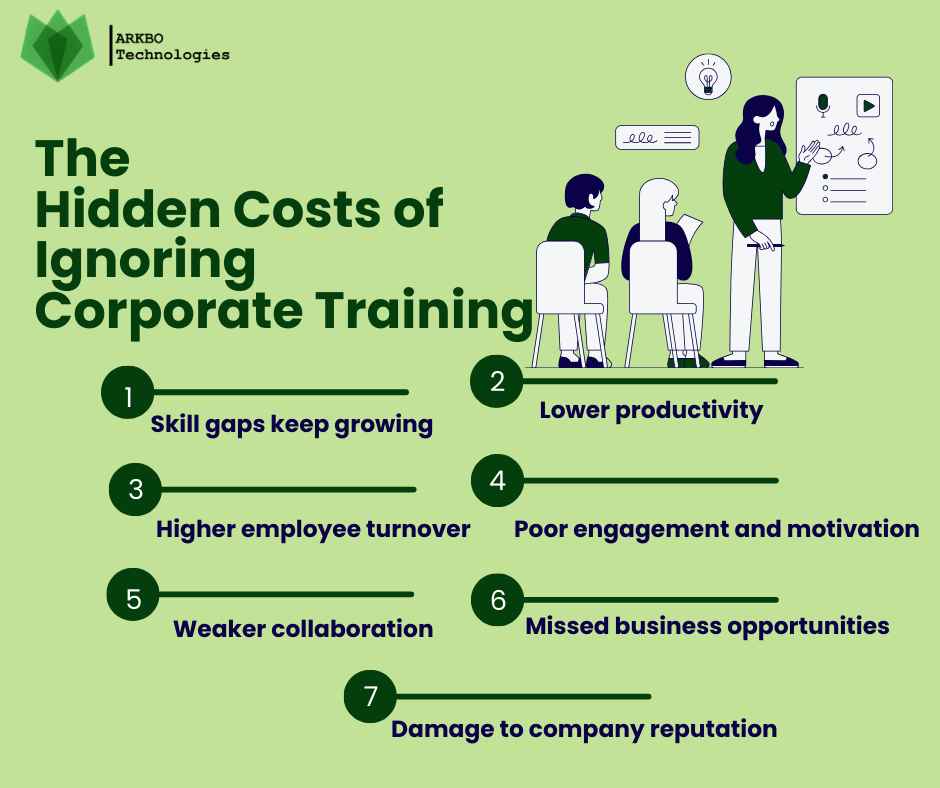
Today is the age of technology, and the work environment changes constantly. It can include new software, updated processes, compliance rules, and many more. Without regular training, employees can continue using outdated methods while the business moves forward. This creates a big skills gap.
But sadly, only 17% of organizations feel confident that they can predict the skills they will need, and just 16% plan to make major investments in learning over the next three years (much skills).
As skill gaps grow, employees struggle to perform even basic tasks efficiently. They can make small errors frequently, which affects the work quality. Over time, teams become dependent on a few experienced individuals, creating bottlenecks and burnout.
These skill gaps slow execution and limit the organization’s ability to scale or innovate.
When employees don't receive the required training, they spend more time figuring things out on their own. They rely on trial and error, ask repetitive questions, and redo work that could have been done the first time correctly. This makes the managers spend extra time supervising instead of focusing on strategic work.
Eventually, the tasks that should take minutes stretch into hours. When this multiplies across teams and months, the productivity losses become significant. The organization pays full salaries but receives reduced output. Overall, it increases operational costs and reduces overall business efficiency.
Fun Fact: Firms spending more on training achieve 57% higher sales and 37% greater profit per employee ( Schoox).
Employees want to grow their careers rather than stay stagnant. When relevant training is missing or not provided, they feel stuck and unsupported.
Over time, they begin looking for opportunities elsewhere, especially if competitors offer learning and development programs. This results in an employee leaving the organization.
Replacing employees is expensive, as losing trained employees costs far more than investing in their development.
The new cycle of hiring, onboarding, and retraining new staff requires time, money, and management effort. And the new hires also take months to reach full productivity, creating additional hidden costs.
4. Poor engagement and motivation
When organizations focus on employee training, it signals that the company values its people. When they are not provided with opportunities to grow, they feel overlooked. They stop seeing a future in the organization and emotionally disconnect from their work.
Disengaged employees do only what is required. This results in making them avoid other responsibilities, stop sharing ideas, and lose interest in betterment. This silent disengagement often goes unnoticed until performance drops significantly.
Many workplace issues stem from poor communication, unclear roles, and a lack of teamwork. Training helps employees understand how to work together, communicate clearly, and solve problems collectively.
Without training, misunderstandings increase. Teams work in silos, conflicts arise, and information does not flow smoothly. This slows decision-making and affects project outcomes. Eventually, this weak collaboration leads to work delays, mistakes, and inefficient teamwork.
Markets change quickly. New tools, customer needs, and business models require updated skills. An under-trained workforce struggles to adapt, delaying responses to new opportunities.
By the time teams are ready, competitors may have already moved ahead. Opportunities are lost not because of a lack of ideas, but because employees are not prepared to execute.
Employees represent the company. When they are poorly trained, service quality becomes inconsistent. Customers experience delays, errors, and frustration, which affect trust and loyalty.
Over time, negative experiences spread through reviews, word of mouth, and industry perception. Once reputation is damaged, rebuilding credibility takes significant time and effort.
When companies skip employee training, the impact isn’t immediate; the problems build quietly over time. This eventually affects employees, daily operations, customer experience, and overall business growth. What seems like a short-term cost saving often turns into a long-term loss.
Corporate training can be offered via various courses that cater to both immediate job requirements and long-term business needs. Some of the common training categories include:
Role-based and technical training to help employees perform their daily tasks efficiently and accurately.
Process and system training to ensure smooth use of internal tools, software, and workflows.
Compliance and policy training to meet legal, safety, and regulatory requirements
Leadership and management training to develop decision-making, communication, and people management skills.
Soft skills training, such as communication, teamwork, problem-solving, and time management.
Bonus Point: A balanced training strategy, including all these trainings, ensures employees grow alongside the organization.
ARKBO Technologies a leading IT and innovation-driven company having a goal to bring products and solutions that cater to corporate operations, including workforce training.
Through ARKBO LMS, organizations can offer a digital platform for employee learning and training. They can create structured learning paths aligned with business goals, monitor employee progress in real time, and measure training effectiveness through actionable insights. Since the platform considers all types of learners, it also aids in the organization’s mission for inclusive and equitable training opportunities.
Also, organizations can purchase training courses on ARKBO courses, which include employee mental health course, business etiquette course, AML/CFT training course, etc. With these courses, organizations build a skilled workforce, improve performance, and support long-term business growth.
Neglecting corporate training may appear to reduce costs in the short term. But it results in significant hidden consequences, including skill deficiencies, reduced productivity, high employee turnover, and disengagement.
Thus, prioritizing employee development and training ensures they possess the necessary skills to meet business objectives.
A comprehensive training strategy should encompass technical, compliance, leadership, and soft skills. When facilitated by solutions such as ARKBO LMS, it fosters a competent and motivated workforce while supporting sustainable long-term organizational success.
Contact us if you want to take a step ahead with ARKBO LMS and Courses.