Did you know 94% of employees say they would stay longer at companies that invest in their career growth? Understanding this scenario, organizations are putting their effort into employee training.
However, it is sad to say that many organizations still feel stuck in generic training that does not match employees' roles, goals, or daily pressures. Because of this, employees struggle to find time for learning that feels disconnected from real work. L&D teams battle low completion rates, limited budgets, and leaders asking for proof of impact.
The result is frustration on both sides. Learners disengage. Organizations miss skill targets.
So the real challenge is this: how do you create learning that engages the learner? To answer that, we must first define what learner engagement truly means.
What Is Learner Engagement?
Learner engagement refers to the degree of attention, motivation, and personal investment employees bring to training. It goes far beyond logging into an LMS or clicking through slides.
Engaged learners understand why the topic matters to them. They connect training to their role, their goals, and the challenges they face every day. They actively participate, apply what they learn, and look for ways to deepen their knowledge.
Engagement is not optional in today’s workplace since employees operate in an environment filled with distractions. Messages arrive constantly. Social platforms are engineered to capture attention.
At the same time, some training programs remain long, dense, and disconnected from real work situations.
Most importantly, three major barriers repeatedly undermine employee engagement in corporate training.
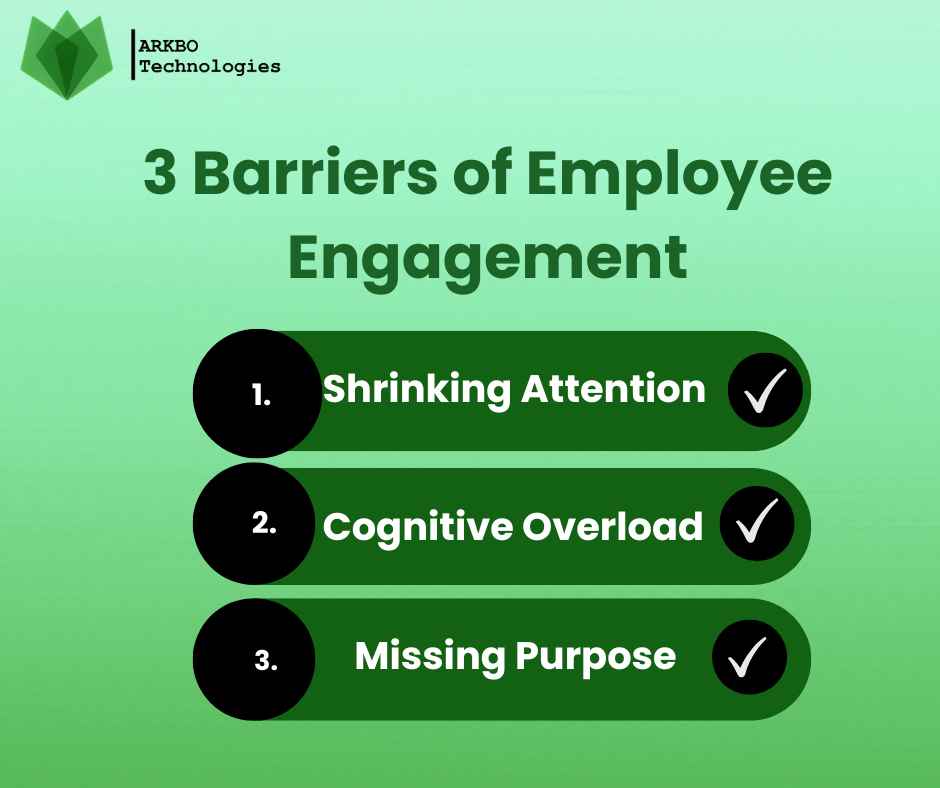
The first is shrinking attention. Learning must now compete with phones, meetings, and task switching.
The second is cognitive overload. When organizations add more content without guidance or structure, learners feel overwhelmed.
The third is missing purpose. When people cannot see how training benefits them personally, motivation fades. The silent question becomes, “Why am I doing this?”
Thus, understanding the various types of learner engagement becomes necessary. Some of them are as follows:
Behavioral Engagement concentrates on getting learners to actively participate, complete tasks, and stay focused. Using varied formats helps prevent fatigue and keeps sessions fresh.
Cognitive Engagement shows how deeply employees understand content. Scenario-based learning, debates, and problem-solving help connect ideas to real workplace situations.
Emotional Engagement builds motivation through storytelling and recognition, such as badges or certificates. Training in emotional skills like communication and self-awareness also supports adaptability.
Self-Directed Engagement emerges when learners take ownership of their growth through personalized content, adaptive learning tools, and clear career pathways.
Social Engagement grows through collaboration in group projects, forums, peer reviews, and mentoring programs that create connections and shared learning.
Let’s look into the core 5 ways organizations can improve employees’ engagement in their training and learning activities.
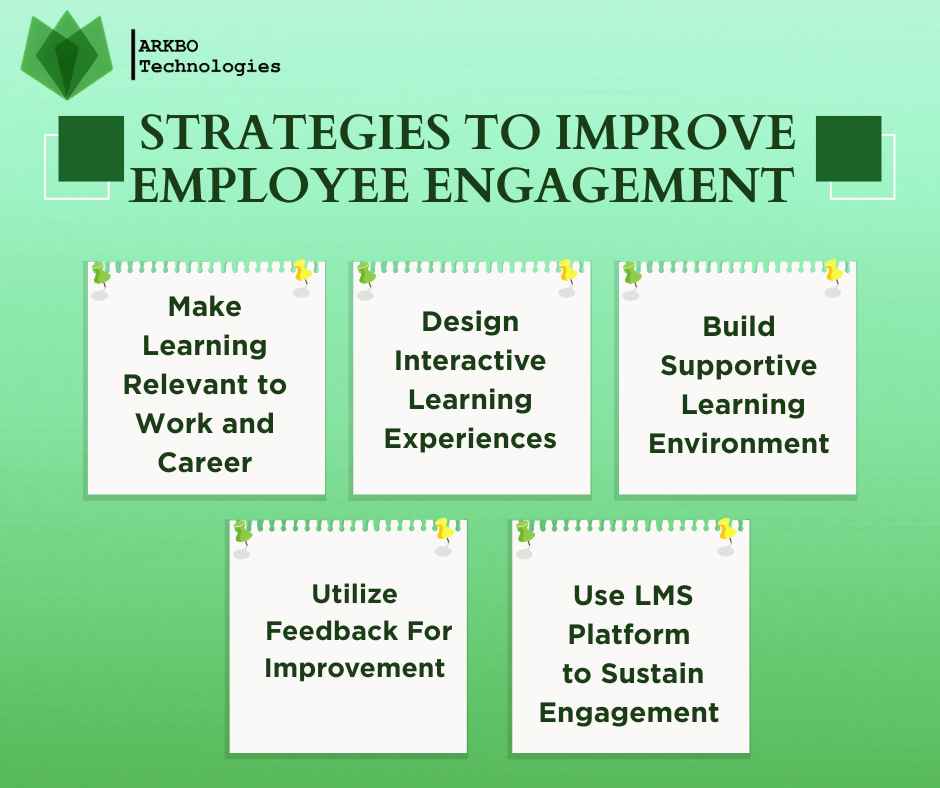
Employee engagement rises when training clearly connects to real responsibilities and future growth. Courses built around generic knowledge or broad theory often fail because employees struggle to see immediate value.
Thus, you need a high-impact learning programs that focus on:
Role-specific skills and business priorities
Real-world company scenarios and case studies
Performance challenges employees face daily
Career progression and leadership pathways.
Consider understanding How Much Time Should You Give for Training and Learning to make engagement without worries or guilt.
Lengthy, information-heavy courses often overwhelm learners and reduce completion rates. Thus, breaking training into shorter modules helps employees absorb material while fitting learning into busy schedules.
Further, you can include the following effective ideas:
Microlearning lessons targeting one concept at a time
Scenario-based exercises and simulations
Knowledge checks and reflection prompts
Visual summaries and job aids
Higher interactivity keeps learners mentally involved and supports deeper understanding, while smaller milestones create momentum.
Training is more engaging when reinforced by collaboration and leadership support rather than completed in isolation. Peer interaction encourages discussion, problem-solving, and shared learning.
Organizations can strengthen social learning by introducing:
Cohort-based programs or study groups
Mentoring and coaching relationships
Discussion forums and community channels
Peer presentations and knowledge sharing sessions
Managers further amplify engagement when they set learning expectations, follow up on progress, and help employees apply new skills on the job.
Sustainable engagement depends on regular evaluation and refinement. L&D teams should monitor participation patterns and learning outcomes to understand what is working and where adjustments are needed.
Useful indicators of good learning engagement include:
Completion and drop-off rates
Assessment results and skill mastery
Learner satisfaction surveys
On-the-job performance improvements
Time spent in learning modules
These insights allow organizations to redesign low-impact content, improve pacing, and focus resources on strategies that deliver real business value.
A Learning Management System (LMS) plays a central role in bringing all engagement strategies together. When used effectively, an LMS supports structured development journeys rather than disconnected courses.
An engagement-driven LMS provides:
Role-based and skill-aligned learning paths
Mobile-friendly access for anytime learning
Automated reminders and progress tracking
Data dashboards for engagement analysis
Integration with HR systems and performance frameworks
By combining personalization, accessibility, analytics, and career alignment, LMS platforms become the foundation for long-term employee development.
ARKBO LMS- one of the most loved LMS in Nepal, is designed around the core principles of learning styles, expectations, and expected results for both employees and L&D of the organization.
Enhanced Productivity: It equips employees with relevant skills, boosting their confidence and performance. Engaged employees work more efficiently, contributing directly to organizational growth through streamlined processes and faster task completion.
Check out our blog 5 Strategies to Improve the Performance of Underperforming Employees, to improve engagement and work performance of employees.
Higher Retention Rates: By fostering continuous learning and development, ARKBO LMS helps employees feel valued and supported. This sense of recognition increases loyalty, reduces turnover, and lowers the costs of recruiting and onboarding new talent.
Scalable Learning Solutions: Designed for organizations of any size, ARKBO LMS ensures consistent skill development and engagement across small teams or large workforces, supporting business growth without compromising learning effectiveness.
Flexible Learning Opportunities: Employees can access training anytime, anywhere, integrating learning seamlessly with work and personal commitments. Self-directed learning empowers employees to progress at their own pace, enhancing engagement and ownership of professional growth.
Real-Time Insights and Recognition: Analytics and engagement tools provide actionable data on training effectiveness and satisfaction, allowing organizations to make informed improvements. Recognition features such as badges and certifications reward achievements, reinforcing learning and fostering a positive, motivating culture.
A study by Survey Monkey shows that 86 percent of employees view job training as important, and 74 percent are willing to learn even outside regular work hours. This makes one thing clear: people want to grow, and organizations must focus on improving the training and learning environment, along with employee engagement.
Learner engagement grows when training respects employees’ time, connects clearly to their goals, supports emotional well-being, and encourages collaboration. When training educates and inspires at the same time, employees do more than complete courses. They change how they work.
In today’s fast-moving business environment, investing in an effective LMS is not just a smart move. It is essential for long-term success and competitive advantage.
By prioritizing personalized and engaging learning experiences, organizations can build a workforce that is motivated, skilled, and loyal.
As the business landscape continues to evolve, ARKBO LMS offers a flexible and scalable platform that keeps employees engaged, empowered, and ready for the future.
Also, we have distinct corporate courses necessary for your ease. Check out our ARKBO Courses.
Start engaging your employees more effectively today with ARKBO LMS and ARKBO Courses. Contact ARKBO to learn more.