On Falgun 21, 2082, Nepal went through the need of the year “Parliamentary Election”. For every Nepali citizen, this election was a way to practice democracy and get the country on a better route, post the sorrow of the Gen Z movement and loss of lives.
But for businesses, the election may bring uncertainty and risk. Whether you run a startup in Kathmandu, manage distribution in Madhesh, operate a factory in Biratnagar, or oversee a retail business anywhere in Nepal, the election can make an impact.
In an environment of uncertainty, business leaders have one key question:
'How can we keep operations stable when everything around us feels uncertain?'
This guide focuses on practical risk management steps for Nepali businesses after the 2082 elections.
Let’s get started.
Post-election risk management for businesses is the systematic process of identifying, assessing, and mitigating potential threats that could impact a business during uncertain or high-risk periods.
For such management, a business’s operations, reputation, finances, or employees, ensuring continuity and stability
In fact, for proper risk management, a business must identify three key layers of risk:
Reputational Risk – This includes false information, social media rumors, or misleading content that can damage trust and brand image.
Cybersecurity Threats – This includes hackers exploiting high digital traffic and political distraction, targeting sensitive business systems.
Physical & Operational Disruptions – This includes roadblocks, office closures, or staff shortages that can interrupt normal business activities.
By understanding these layers, businesses can plan proactively, safeguard operations, and maintain stability during election periods.
A nationwide election in 2082 B.S. can bring both positive and negative impacts. The positive impact includes increased demand for hotels, cafes, printers, transportation, and food vendors; these certainly provided a temporary hike in economic activities.
However, negative impacts are also equally possible. Some of them are:
Businesses wait before growing: Companies often delay expansion, buying equipment, or hiring new staff until the election results are known.
Rules and costs may change: A new government can change taxes, tariffs, or laws, which can increase business costs or affect how companies operate.
Foreign brands become cautious: Political instability makes global brands unsure about investing or placing orders in Nepal.
Slower growth after elections: Economic activity may slow down while the new government settles in and updates its policies.
The post-election landscape is likely to be defined by limited fiscal space, rising national debt, and potential policy shifts. Thus, businesses must navigate this period by shifting their strategies from reactive waiting to proactive risk management.
Here are the essential steps to managing business risk in the aftermath of the 2082 election:
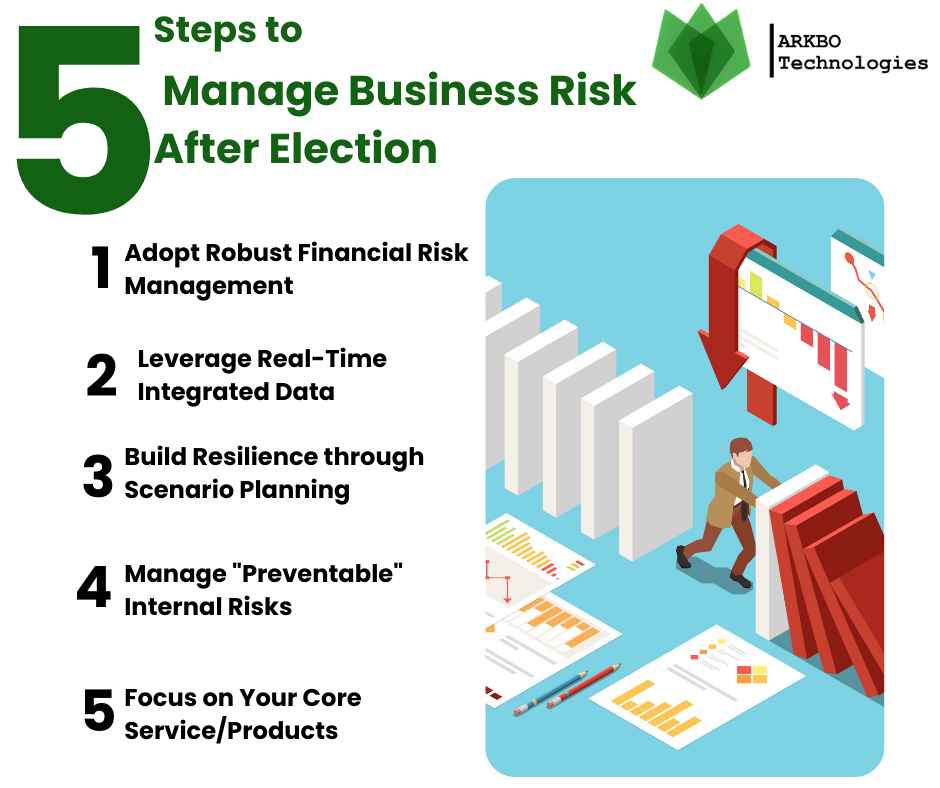
First and foremost, businesses should implement strong cash management strategies to maintain liquidity and reduce the need for expensive external borrowing. For that, they can work on:
Foreign Exchange (FX) Management: Here, you must understand how potential volatility impacts your balance sheet and revenue.
Hedging Strategies: Consider automated hedging to reduce earnings volatility and protect against sudden currency movements.
To react swiftly to new policy directions, an organization needs a "single source of truth."
For that, the organization can centralize data, which helps you understand discrepancies by ensuring that all departments work with consistent, accurate information.
With data available, the company can get predictive insights so that it can anticipate potential risks and identify gaps in its data before they affect the bottom line.
Using the data, you can ask yourself and try to get SMART answers for:
What are your upgrade plans for the year ahead?
What has your data been telling you about your customers, your marketing initiatives, your inventory, your supply chain?
Has your collection and analysis created any bottlenecks in high-level decision-making? How are you going to avoid analysis paralysis?
After elections in Nepal, the political landscape often shifts rapidly, with coalition governments and changing priorities creating uncertainty for businesses.
To avoid getting stuck in analysis paralysis, organizations need to move beyond basic forecasting and plan for multiple scenarios. To do that, regular stress testing can be done; it helps businesses understand how economic or political changes could impact operations.
It is equally important for businesses to build adaptability within the organization. They can absorb shocks, adjust quickly, and continue operating smoothly, and are more likely to thrive despite volatility.
While businesses cannot control what happens politically, they do have the power to strengthen their internal operations.
During transitional periods, it is a good idea to review workflows, streamline processes, and reduce unnecessary costs. This not only improves efficiency but also makes the organization more resilient to external shocks.
Understanding internal risks is also helpful for companies to remain prepared, no matter what changes come from the outside.
Businesses rarely have all the answers, especially when the future feels uncertain. One way to adapt to uncertainty is by focusing on products and services that consistently deliver value to your customers.
Businesses can identify which services/products are most essential to their loyal clients and highlight these in both their marketing and operations.
By doing this, they can make sure their business stays relevant and maintains steady revenue, despite shifts in consumer behavior during post-election or uncertain economic periods.
Post 2082/83 Nepal election can create uncertainty for businesses of all sizes. It can affect daily work, finances, and employee confidence. By understanding risks, cyber threats, and work disruptions, businesses can prepare in advance and stay stable.
This “super election year” may change the national economy for many years. Thus, companies that use technology, stay flexible, and think globally can turn political uncertainty into long-term growth opportunities.
ARKBO Technologies empowers organizations to grow stronger in times of change through smart digital transformation and workforce-focused solutions. By combining technology with people-focused systems, ARKBO enables businesses to remain agile, resilient, and competitive.
All in all, solutions from ARKBO Technologies can be a great help for organizations to stay prepared for the post-election situation.
Contact our team to see how ARKBO can strengthen your business and empower your team.